Latent Conditions and Decisions
A hidden condition is not just a technical finding. It is a project decision waiting to be made.
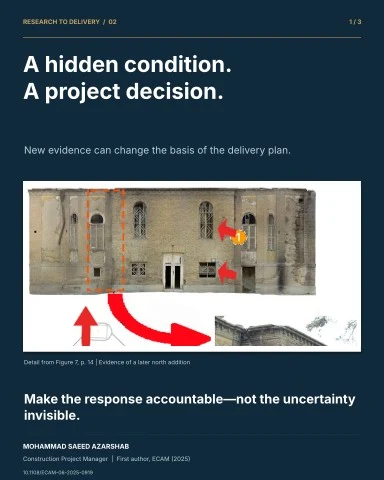
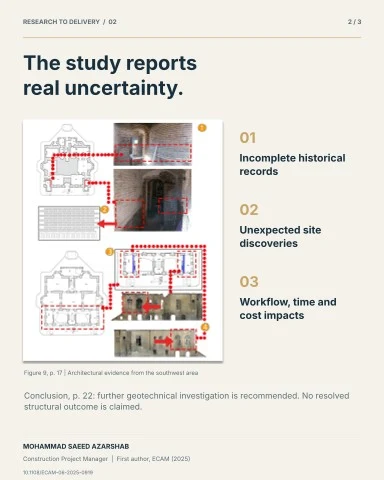
In our published study of the Zahir-ol-Islam House, incomplete historical records and unexpected site discoveries complicated the interpretation of the building.
The paper reports that these discoveries disrupted the planned workflow and increased both time and financial expenditure.
That is the part of the case I find especially relevant to construction project management: new evidence can change the basis on which the work was planned.
Investigations also identified walls built directly on soil. The paper recommends comprehensive geotechnical investigation; it does not establish that the long-term structural questions have been resolved.
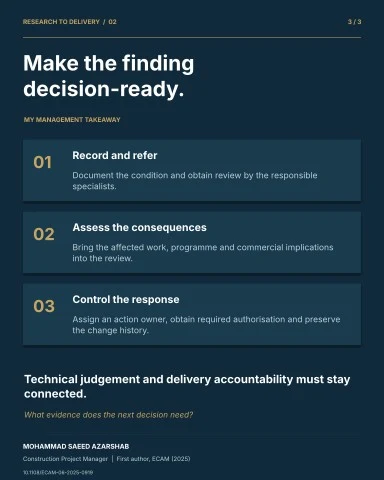
For me, the response starts by making the finding usable for the people responsible for the decision.
I would want the condition documented and referred to the relevant specialists, with the implications for affected work assessed before proceeding. The planner and commercial team need to understand what has changed, while the client needs a clear explanation of the available options and remaining uncertainty.
The next action should have an owner. Any authorised change should be reflected in the current plan without losing the original baseline or the reason for the revision.
As a Construction Project Manager, I do not need to replace the engineer’s judgement. I need to ensure that judgement reaches the right decision-makers and changes the delivery plan where necessary.
My standard is not a report that makes uncertainty disappear. It is a process that makes the response accountable.
What should a site-discovery report contain before it reaches your project review?
Based on my first-author case study in Engineering, Construction and Architectural Management.
Accompanying visuals