Recovery That Can Be Delivered
An earlier date is not a recovery plan.
When I look at an activity that has been moved forward, I want to know what changed to make that earlier start possible.
Has the preceding work been released? Is the required information approved? Can the trades share the area without creating a new constraint? Are the necessary people and materials available?
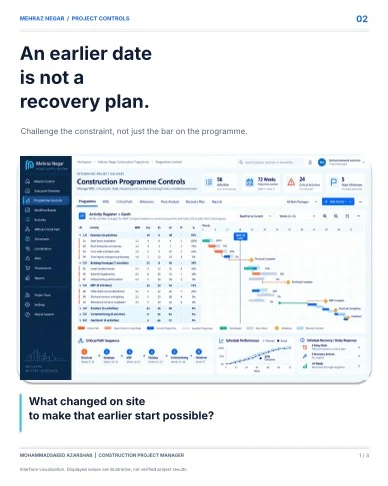
Those questions shaped the Programme Controls view in Mehraz Negar, the construction-management platform I designed and developed.
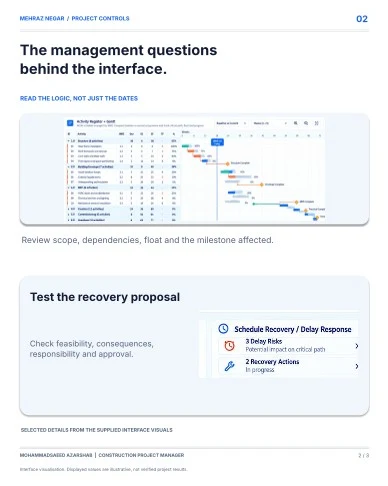
The view brings work packages, dependencies, critical-path information, float, milestones and baseline-versus-current programme information into one review context.
The management task is to use that context well.
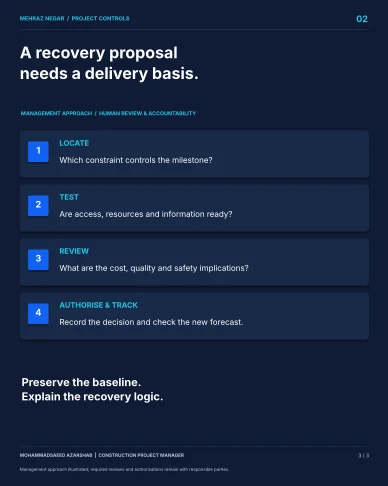
Consider a proposal to overlap two activities. I would want the planner and delivery team to explain which work can genuinely proceed in parallel, what access is required and which inspections or technical approvals must remain in sequence.
I would also want the commercial consequences and any transfer of risk made visible. Saving time in one area is not enough if the proposal creates an unmanageable problem for another trade.
The agreed response then needs an owner, the appropriate approvals and a way to check whether the revised forecast still holds as work progresses. I would keep the approved baseline visible rather than overwrite the original commitment.
The software supports that conversation. It does not replace the planner’s judgement, specialist review or the authority required to approve a change.
For me, programme control means being able to explain why a date is achievable—and what the team must do to make it so.
What evidence would you ask for before accepting a recovery proposal?
Accompanying visuals